Packs, transcripts, administrator reports, prior minutes, attendance details and resolutions have to be reconciled manually.
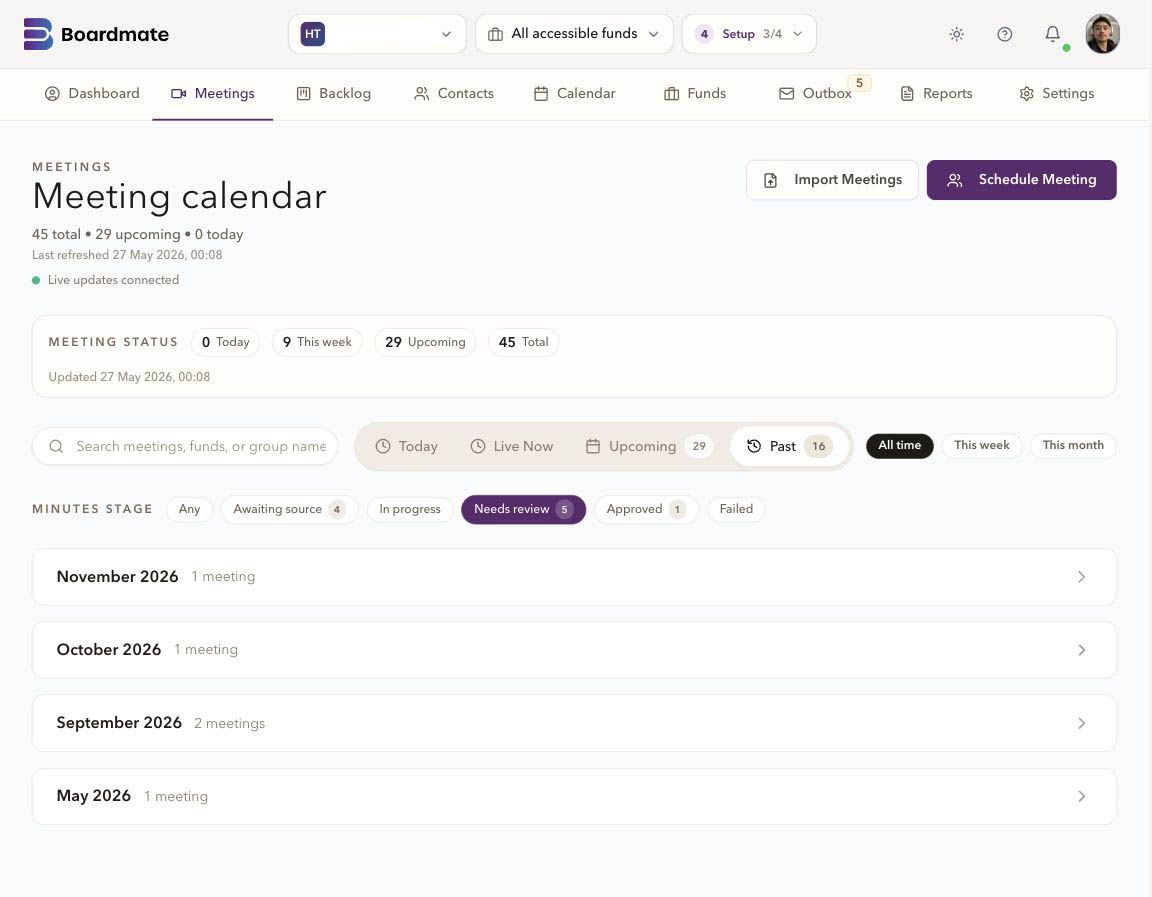
The meeting record keeps source material, draft minutes, reviewer activity, chair decisions and exports together.


Solutions
Boardmate is shaped around formal Cayman fund board workflows: source material, defined terms, approvals, reporting cycles, annual obligations, service provider inputs, and review expectations.
Attendance, quorum, declarations, approvals, reports, resolutions, and matters arising need precision.
CIMA, ESN, FAR support, FATCA/CRS, AML, governance review, and service inputs can be tracked.
Directors, administrators, legal reviewers, auditors, and service providers need controlled access.
Formal record: Attendance, quorum, declarations, approvals, reports, resolutions, and matters arising need precision.
Annual cycle: CIMA, ESN, FAR support, FATCA/CRS, AML, governance review, and service inputs can be tracked.
Reviewer access: Directors, administrators, legal reviewers, auditors, and service providers need controlled access.
Evaluation: Use ordinary, complex, short, adjourned, and annual-review meetings to test Cayman-style drafting and workflow without exposing a broad archive.
Request provider reports and updates, review what has arrived and prepare a PDF pack in the order the board will read it. Contributors use their shared workspace while board support controls what is accepted and circulated.
Boardmate speaks to directors, administrators, and service providers who expect formal minutes, clear approvals, reliable action follow-up, and a board record that can carry into the next meeting.
Investment managers want confidence that board meetings happened, minutes were approved, open actions are known, and annual obligations have a clear status. Companion gives the CSP a record it can use in those client conversations, without turning every status question into an inbox search.
Approved minutes, review history, and exports remain tied to the fund record.
Actions, provider inputs, approvals, and annual task status can be reviewed together.
The CSP can answer status questions without rebuilding the position from inboxes.
Annual CIMA fee status, economic substance notification, annual return work, audited accounts and FAR support, FATCA/CRS tasks, AML training, governance review, and service provider reporting can all create agenda, board pack, minutes, approval, and follow-up work where applicable.
The first market context is Cayman fund boards, but the core workflow applies to other formal board settings where repeat meetings, external reviewers, deadlines, and approvals need a controlled workspace.
A small batch with ordinary, complex, and short meetings can test quality without exposing a broad archive at the start.
Boardmate Companion
For Cayman fund portfolios, the burden is the repeat work of keeping service provider inputs, board papers, filing support, director approvals, minutes and follow-up moving across hundreds or thousands of funds.
Professional advisers and filing portals still do the specialist work. Companion gives board support teams, corporate service providers and fund administrators the operating layer around them: calendar, requests, review, minutes, approvals, reminders and the next cycle.
Companion is designed around fund records, not a loose task list. That matters when Cayman obligations depend on the entity, regulatory profile, fiscal year end, responsible provider and board review pattern.
CIMA fees, economic substance notification, annual return and registration fee work, audited accounts and FAR support, FATCA/CRS items, AML training and governance review can be planned as recurring work where applicable.
Administrators, auditors, FATCA/CRS providers, legal reviewers and directors can be tied to report requests, secure upload links, board pack assembly, reminders and status.
First-half and second-half obligations can be reviewed against the relevant meeting, with overdue, upcoming, discussion and approval items surfaced before the board pack is finalised.
Minutes, approvals, action items, service provider status, reminders and audit history stay connected, so the next board cycle starts from what happened last time.
Portfolio operating layer
Jurisdiction, regulatory profile, year end, directors, service providers, recurring meetings and annual review pattern.
Report request, responsible provider, secure upload route, due date, reminders, receipt status and exceptions.
Agenda, previous minutes, reports, supporting papers, late changes and readiness status before circulation.
Draft minutes, reviewer comments, support uploads, chair decisions, approvals, actions and audit history.
Carry-forward actions, filing support status, annual task reminders and the context needed for the next meeting.
Cayman examples
Annual fees, registration, annual return and economic substance status where applicable.
Audited accounts, FAR support and operator-declaration status for private funds where applicable.
FATCA/CRS notification, reporting and CRS compliance form status where relevant.
AML training, policy review, service provider review, director decisions and recurring actions.
When the same preparation, minutes, review and follow-up pattern repeats across hundreds or thousands of funds, Companion reduces the loose tracking work around every meeting.
Board packs, minutes, approvals, actions and annual obligations follow one workspace pattern instead of depending on local inbox habits.
Open requests, overdue items, approvals, review responses and follow-up can be checked before the meeting record moves on.
Common questions
No. Reviewer comments are review input. The chair or delegated board support user decides which feedback shapes the next draft.
Yes. A first evaluation usually works best with several ordinary meetings, one complex meeting, one short or adjourned meeting, and prior minutes that show house style.
Lite is the backlog-clearing workbench. Companion is the broader board cycle workspace for agendas, report requests, board packs, annual compliance tasks, actions, approvals, reminders, and governance memory.