Lite is the focused Boardmate product for turning historic meeting material into reviewed formal minutes.
Use this page when a colleague needs the Boardmate Lite shape quickly before reading the longer evaluation, import, review, or security guides.
01
Material to bring
A rough count of backlog meetings and the range of entities, meeting types, and source quality.
The source material held for those meetings: transcripts, recordings, board packs, support notes, separate reports, and actions.
The current review workflow, including chairs, attendees, service providers, legal reviewers, and final approval owner.
The confidentiality or security review questions that must be answered before real sample files are uploaded.
02
Boardmate checks
Can Lite make a backlog visible by status, source readiness, review stage, and next action?
Can the team run a small representative sample without committing the whole archive at once?
Can reviewers comment through private links while the chair or delegate controls regeneration?
Can the final package include DOCX, PDF, actions, and audit trail for the file?
03
Red flags
The problem is mainly live agenda planning, report requests, or compliance calendar management rather than historic minutes backlog.
No one can provide prior minutes or style examples, so quality can only be judged against a vague expectation.
The organisation wants reviewer comments but has not named who decides whether feedback changes the record.
The organisation needs the whole live governance cycle from day one, which may make Boardmate Companion the better first conversation.
Result of the exercise
Immediate use
Clear a defined backlog tranche with a representative sample before wider rollout.
Decision record
Time saved, formal style, reviewer control, DOCX usefulness, and audit clarity.
Expansion
Boardmate Companion when agendas, board packs, report requests, actions, approvals, and governance memory need one workspace.
Boardmate view
A one-pager should answer the questions it is meant to answer. Its job is to make the product shape legible quickly: what Lite is for, what the team provides, what Boardmate returns, and what a first evaluation should show.
The useful version is specific enough to forward to colleagues. A colleague should understand that Lite is about backlog clearance, source-folder preflight, formal house-style drafting, private review, chair-controlled regeneration, DOCX and PDF output, action items, and audit trail.
Worked examples, checklists and planning tools
Lite detail
The one-pager helps a colleague reach the right decision.
A one-pager can be short without being thin. Its job is to help a busy leadership sponsor, chair, board support lead, administrator, or legal reviewer understand whether Lite is relevant enough to read further or book a conversation.
The one-pager does more than promise faster drafting. It explains the focused workflow: backlog material enters through CSV and source-folder preflight, Boardmate drafts formal minutes, reviewers use private links, the chair or delegate controls regeneration, and the team receives DOCX, PDF, action items, and audit trail.
Use case
Say when Lite is the right first step.
Lite is right for historic minutes, delayed drafts, and backlog pressure where source material exists and formal DOCX output still matters.
Limit
Say when Companion may be the better answer.
If the team needs agendas, board packs, report requests, live actions, approvals, and governance memory from day one, Companion belongs in the conversation early.
Next
Send the reader to a concrete follow-up.
The one-pager points to evaluation planning, CSV preparation, review control, security review, or a demonstration.
How to run it
Use the one-pager as a team decision aid.
The strongest one-pager saves colleagues from reading the wrong material. It answers enough to create a useful next step.
01
Identify the pain in one sentence.
Backlog clearance, delayed first drafts, scattered source material, reviewer chase, or a weak approval trail is named plainly.
Backlog count
Current bottleneck
Leadership concern
02
Explain the exchange.
The team provides a manifest, source folder, style reference, and reviewer list. Boardmate returns drafts, review control, regeneration, exports, and audit history.
Inputs
Outputs
Responsible person
03
Name the first test point.
A representative five to ten meeting sample gives a colleague a concrete way to judge quality, control, and practicality.
Sample size
Meeting mix
Success criteria
04
Guide the next reader.
Board support may need the CSV guide, the chair may need the review guide, IT may need security detail, and the commercial sponsor may need the evaluation checklist.
Reader type
Relevant guide
Demo page
05
End with a next decision.
The reader leaves with one of four next steps: prepare a Lite sample, send security questions, compare Boardmate Companion, or book a focused demonstration.
Lite sample
Security questions
Companion comparison
Worked scenario
A one-pager that does its job.
A leadership sponsor sends the page to board support and the chair. Board support recognises the backlog-clearance use case and opens the CSV guide. The chair reads the review-control section and asks who decides accepted comments. IT asks for the secure workflow page before sample files move.
That is a successful one-pager. It does not close the whole sale. It creates the right next conversations without making Boardmate sound like a generic drafting tool.
Leadership sponsor
Understands when Lite is right and when Companion may follow.
Board support
Knows what source material and style reference would be needed.
Chair
Sees where feedback control and regeneration decisions sit.
IT or legal
Knows the security guide comes before real confidential upload.
A good result
Specific
The page explains the actual Lite workflow, not a generic AI-minutes promise.
Honest
It distinguishes backlog clearance from the wider Companion board cycle workspace.
Actionable
Each reader can see the next guide or conversation that applies to them.
Circulable
The language is precise enough to forward without extra explanation.
Boardmate review
Use this guide to share the Lite story as a specific backlog-clearance workflow.
Immediate use
Lite is the focused workflow for historic minutes and delayed drafts where source material already exists.
Input shape
CSV manifest, source folder, prior minutes, board packs, transcripts or recordings, notes, reports, and reviewer list.
Output shape
Formal drafts, private review, accepted feedback, chair-controlled regeneration, DOCX, PDF, action items, and audit history.
Growth plan
Boardmate Companion extends the same record into agendas, board packs, report requests, actions, approvals, compliance history, and live board cycles.
Worked example
Example team briefing note.
The one-pager should help a busy colleague know whether to read more. It should say who Lite is for, what the team provides, what Boardmate returns, what the first evaluation shows, and where the conversation goes if the backlog workflow works.
It should also stop the wrong conversation early. If the team needs a live governance workspace from day one, the next page is Companion. If the team needs to clear historic minutes with controlled review and Word output, Lite is the right first test point.
Send to
Board support, chair, administrator, legal reviewer, IT reviewer, or project sponsor.
Ask
Is backlog clearance the first Boardmate use case, or is the live cycle the real problem?
Useful follow-up
Evaluation checklist, CSV guide, review guide, security guide, or demonstration.
Decision ledger
StageTeam questionBoardmate recordDecision
Use case
Is the pain historic minutes or the live board cycle?
Backlog size, source availability, review workflow, DOCX need, and current approval record.
Start with Lite for backlog pressure; move to Companion if the live cycle is the main job.
Readiness
Can the team prepare a representative sample?
CSV, source folder, prior minutes, reviewers, and security scope.
Use the evaluation checklist before asking for a broad commercial commitment.
Record
What would make colleagues believe the product changes the work?
Circulate the one-pager with one concrete next step, not a vague interest note.
Next
Who owns the next conversation?
Named sponsor, board support lead, chair delegate, IT or legal reviewer, and timeline.
Book a demonstration or build the first sample pack.
Watch points
Too broad A one-pager that tries to sell every future workflow will blur the Lite decision.
Too thin A one-pager that only promises faster drafting will sound less mature than the product actually is.
No clear responsibility A briefing is weak if nobody knows who should prepare the sample or approve upload.
Boardroom wording
To a sponsor Lite is the quickest way to test whether Boardmate changes backlog work.
To board support The first test point covers draft speed, source preparation, review control, and final-record confidence.
To procurement The security guide should be read before real confidential files move.
Boardmate toolkit
Give colleagues a useful next step, not a slogan.
The Lite one-pager can be easy to forward and still be specific. A colleague understands the backlog problem, the input pack, the review workflow, the output package, and whether the next conversation is Lite, Companion, security, or a demonstration.
Briefing note
A good one-pager answers who reads what next.
The page earns its place when each colleague can find the right next step. Board support needs the import guide. The chair needs review control. IT or legal needs the secure workflow guide. A sponsor needs the evaluation checklist and the demonstration page.
Use case
Historic minutes, delayed drafts, source material already held, DOCX output needed, reviewer control missing.
Limit
Live agendas, report requests, approvals, compliance calendar, and longer-term governance memory may point to Companion.
Next
Prepare sample, read security pages, compare Companion, or book a focused demonstration.
Import
CSV and source-folder preflight
Lite starts with meeting material the team already holds, then makes source readiness visible.
Backlog
Meeting queue and progress
The product shows what is waiting, processing, ready for review, failed, or ready to export.
Review
Private links and chair control
Reviewers contribute without full portal friction, while accepted feedback remains under chair or delegated control.
Output
DOCX, PDF, actions, audit
The practical promise is a usable minutes package and the history needed to explain it.
Role by role
Project sponsor
Decide whether backlog clearance is the first Boardmate use case.
Backlog count, current delay, sample proposal, and responsible person. Board support
Confirm whether a representative sample can be prepared.
CSV, source folder, prior minutes, reviewers, and style pack. Chair
Check that feedback control and regeneration authority are clear.
Private links, selected-passage comments, accepted feedback, and chair instructions. IT or legal
Read the secure workflow guide before real confidential material moves.
Scope note, data-flow questions, access, export handling, and close-out plan.
Decision route
Too thin
The one-pager promises faster drafting but does not describe Boardmate Lite's actual workflow.
Rewrite around import, review, regeneration, output, and audit. Circulable
A busy colleague understands the use case, inputs, outputs, and next guide.
Use it as the orientation note. Decision-ready
The sponsor can see whether Lite or Companion is the right first conversation.
Prepare the first evaluation. Procurement-aware
Security, access, retention, and deletion questions are raised before upload.
Move toward a controlled sample.
Record note
Forwarding note
The one-pager makes this kind of forwarding note easy to write.
Why read
We have delayed historic minutes and source material already held across folders and emails.
What Lite does
Imports the batch, drafts formal minutes, collects private review, regenerates from accepted feedback, exports DOCX/PDF, and keeps audit history.
What to decide
Whether to prepare a five to ten meeting sample and settle security questions before upload.
Read next
Evaluation checklist, CSV guide, review guide, secure workflow guide, or Companion overview depending on role.
Avoid
Generic drafting claim A one-pager that sounds like meeting notes undersells the product and weakens trust.
Too much platform Trying to sell the entire Companion workspace can blur the immediate Lite decision.
No sample lead A shared one-pager without a named lead rarely turns into a meaningful evaluation.
Security footnote Confidential material cannot be treated as an afterthought just because the page is short.
Fit
Identify whether Lite is the right first conversation.
Lite is right when the immediate pressure is historic minutes or delayed first drafts, and the organisation already holds enough source material to test a sample. It is especially relevant when board support is spending too much time assembling files, chasing reviewers, reconciling comments, or repairing final record.
If the immediate need is live agenda planning, report requests, compliance calendars, approvals, and governance memory across future meetings, Boardmate Companion may be the better first conversation. Many teams will still begin with Lite because backlog pressure is the visible pain.
Lite is worth a closer look when
There is a defined backlog or delayed minutes tranche.
Source material exists but is spread across folders, emails, transcripts, board packs, and support notes.
Reviewer feedback currently arrives through loose email or Word markups.
The team needs DOCX output plus clearer review and audit trail.
Fit note
Immediate pain
Backlog, delayed first drafts, reviewer chase, or file reconciliation.
First record
A representative sample that shows quality, control, and export usefulness.
Expansion
Boardmate Companion if the team also needs the live board cycle.
Inputs and outputs
The exchange is clear.
The team provides a CSV manifest, source folder, prior minutes or style examples, and reviewer list. Boardmate preflights the batch, drafts formal minutes, coordinates private review, lets the chair or delegate decide accepted feedback, and exports a working record.
The one-pager should make clear that the output is more than prose. The practical package is DOCX, PDF, action items, and an audit history that explains source, review, decision, regeneration, and export.
Explain the working package
CSV and source folder before generation.
House-style draft minutes ready for review.
Private reviewer links and chair decision control.
DOCX, PDF, actions, and audit history after review.
Evaluation
Give colleagues a concrete first test.
The first Lite test should be narrow enough to complete and varied enough to mean something. Five to ten meetings usually gives enough material. Include ordinary, complex, short, and imperfect examples. Add prior approved minutes so style is judged against something real.
The working question is simple: does Lite reduce the work of turning source material into approved minutes while improving reviewer control and record? If the answer is promising, the team can decide whether to widen Lite, ask security questions, or discuss Boardmate Companion.
A useful one-pager CTA should point to
Evaluation checklist for sample planning.
CSV and folder guide for source preparation.
Review guide for private links and comments.
Security guide before confidential material is uploaded.
Team handoff
Send to
Board support, chair, administrator, legal reviewer, or project sponsor.
Ask
Is backlog clearance the right first test point?
Next
Book a demonstration or build the first sample pack.
Questions to settle
Is the immediate pain backlog clearance or the wider board cycle?
How many meetings would make a representative first sample?
Who owns reviewer decisions and final approval?
What source material already exists?
Which deeper guide should the colleague read next?
Carry forward
Team record
A suitability note, sample idea, input list, output expectation, and links into deeper guides.
Next action
Share with colleagues, then move to evaluation planning or a demonstration.
Responsible person
The sponsor deciding whether backlog clearance is the right first Boardmate use case.
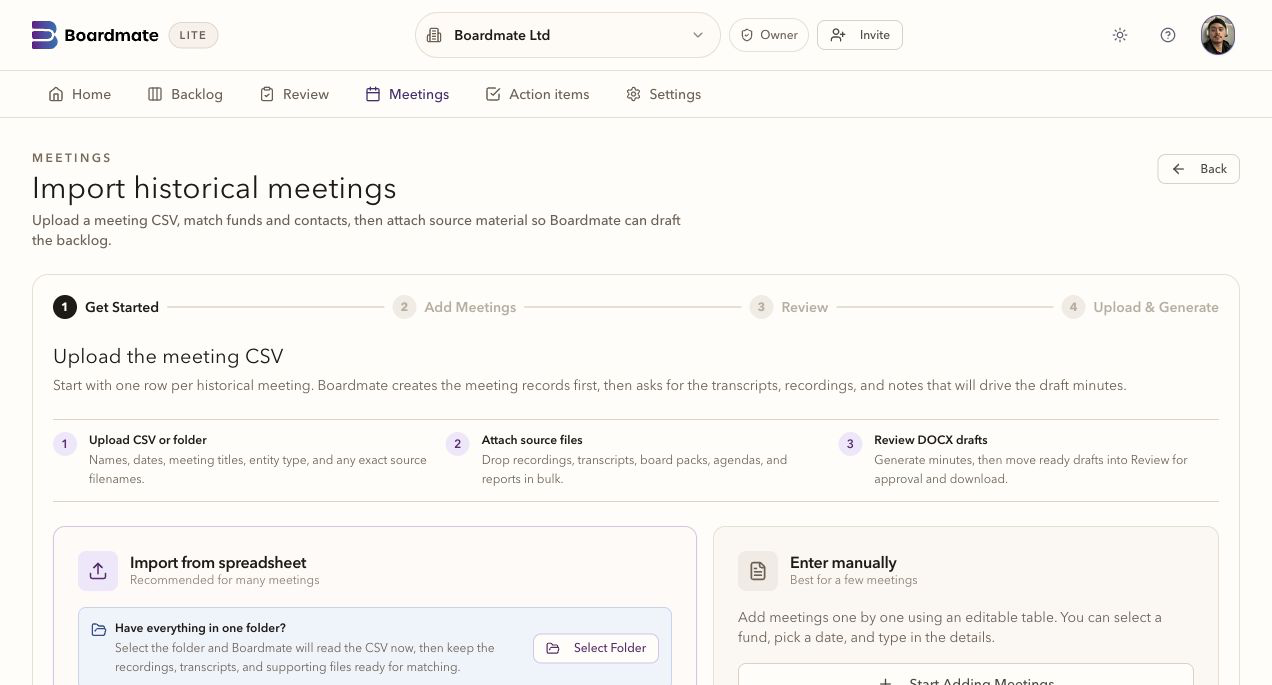
Boardmate Lite is the backlog-clearing product for teams that need formal minutes from historic meeting material. It focuses on turning meeting material into reviewed minutes, without requiring the full board cycle workspace on day one.
Historical meetings waiting for first drafts.
Meeting material spread across folders, transcripts, board packs, support notes, and separate reports.
Reviewer comments currently handled through email or marked-up Word files.
A need for DOCX output plus clearer audit trail.
Inputs
What the team provides.
Lite needs enough source material to produce useful drafts and enough context to check them properly. The first sample should be representative, not exhaustive.
Manifest
CSV meeting list with entity, date, meeting type, chair, attendees, and useful notes.
Source folder
Transcripts, recordings, board packs, support notes, action lists, and separate reports where needed.
Reviewers
Reviewer names, chair or delegated decision maker, and expected approval owner.
Style reference
Prior approved minutes or templates that show the organisation's formal record style.
Workflow
What Lite does with the batch.
Lite preflights the manifest and source folder, drafts formal minutes, coordinates private review, and lets the chair or delegated owner decide what feedback should shape the regenerated version.
Preflight shows what is matched, missing, ambiguous, or ready.
Drafting uses the available source material and house-style examples.
Private links collect passage comments, uploads, and no-comment confirmations.
Accepted feedback and chair instructions become the basis for regeneration.
Outputs
What the team gets back.
The useful output is the working minutes file, the readable copy, extracted follow-up when the source supports it, and the audit trail that explains how the draft moved through review.
DOCX
The practical working file for board support, legal review, or final filing.
PDF
A stable reading copy for circulation or evaluation record.
Actions
Extracted follow-up where the minutes and source material support it.
Audit
Source, review, decision, regeneration, export, and download history.
Evaluation
How to run the first test.
The first Lite evaluation should be practical: agree confidentiality, select five to ten representative meetings, prepare the manifest and folder, generate drafts, run a real review, and compare the result against the current workflow.
Begin with a limited representative sample.
Do include ordinary, complex, short, and imperfect meetings.
Do involve the person who will actually approve the final minutes.
Do judge the workflow, reviewer control, DOCX usefulness, and audit trail together.
Expansion
When Boardmate Companion becomes relevant.
Lite shows the minutes workflow. Boardmate Companion becomes relevant when the organisation wants agendas, board packs, report requests, meetings, actions, approvals, and governance memory to live in one continuing workspace.
Stay Lite
The immediate priority is backlog clearance and controlled review of historic minutes.
Move to Companion
The organisation wants the live board cycle and future records to share the same governance workspace.
Evaluate both
The organisation has backlog pressure now and a broader board cycle improvement project coming next.
Common questions
Lite questions before a first run.
When is Boardmate Lite the right starting point?
Lite is the right starting point when the immediate pressure is a formal minutes backlog that needs source checking, drafting, review, DOCX, PDF, action items, and audit history.
What should be prepared for a Lite sample?
Prepare a meeting manifest, source folder, prior approved minutes, reviewer details, and a chair or delegated approver who can decide which comments matter.
When does Boardmate Companion become relevant?
Companion becomes relevant when the team wants the live board cycle in one workspace: agendas, board packs, report requests, actions, approvals, annual tasks, reminders, and history.