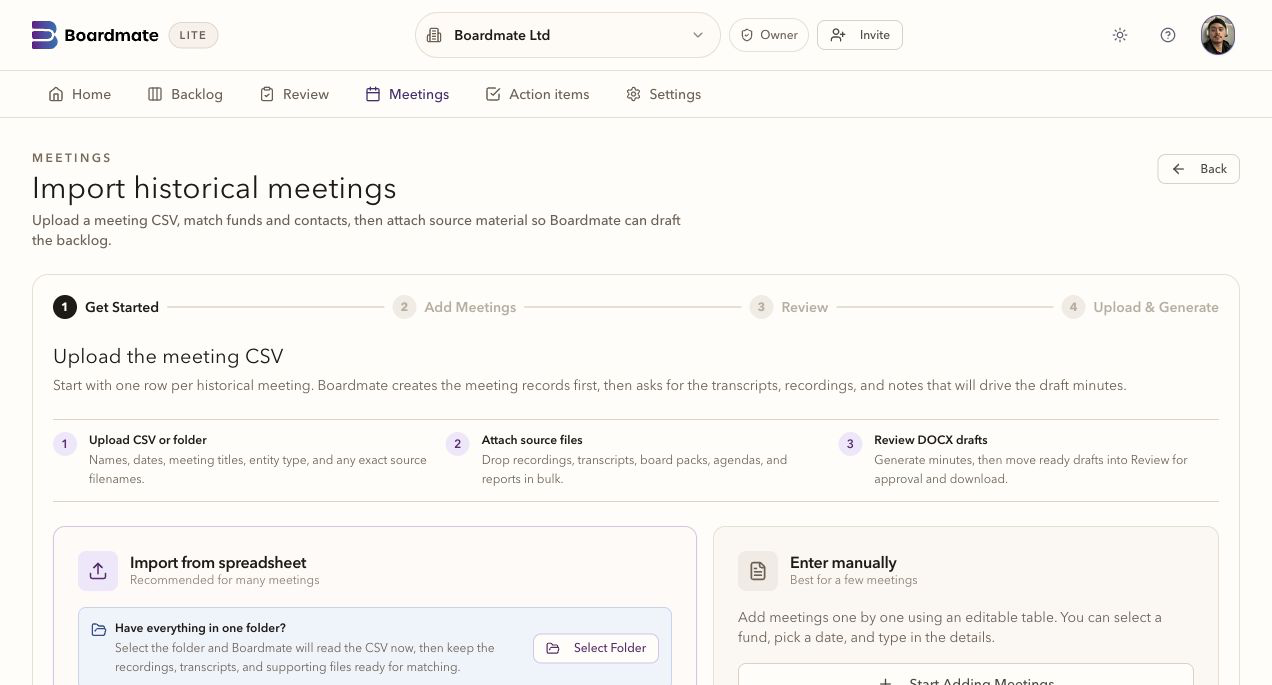
A batch import succeeds when the manifest is clear enough for both Boardmate and a human reviewer.
Use this before the first Lite backlog run, especially when meeting material is spread across old folders, email attachments, recordings, transcripts, board packs, and support notes.
01
Material to bring
The final CSV that will be used for the run, not a rough planning spreadsheet.
A source folder with stable filenames for transcripts, recordings, board packs, support notes, action lists, and separate report files where needed.
A note of known gaps, duplicate files, superseded packs, missing transcripts, or material deliberately left out of scope.
Entity, fund type, chair, attendees, apologies, meeting type, and source-file hints for every meeting row.
02
Boardmate checks
Does preflight make file matching explainable before the first draft is generated?
Can the team identify which files were used, held, added later, or excluded from the sample?
Does the import process reveal uncertainty before the minutes are wrong?
Can the same manifest and source assumptions be kept beside the exported minutes and audit record?
03
Red flags
The CSV mixes meetings and files, making it unclear which row is the meeting record.
Filenames rely on local memory, initials, or private shorthand that another board support user cannot verify.
The batch includes unrelated confidential material because nobody decided what belongs in the sample.
Missing material is discovered only after draft review, when it should have appeared in preflight.
Result of the exercise
Ready batch
CSV, folder, exceptions, and source assumptions are coherent enough to generate.
Correction list
Rows or files needing renaming, additional source material, or explicit exclusion.
Reusable habit
A naming and manifest standard the team can use for the next backlog tranche.
Boardmate view
Backlog material often arrives as a working archive rather than a clean product input. There may be recordings in one folder, transcripts in another, board packs in email, prior minutes in a filing system, and support notes held by one person. A good import process makes that reality inspectable before Boardmate drafts anything.
The CSV is the meeting manifest. The folder is the source bundle. Together they should let a human reviewer reproduce the batch logic: one row is one meeting, source files are named so they can be matched, and exceptions are visible before they affect the minutes.
Worked examples, checklists and planning tools
Import detail
The import is where backlog confidence is won or lost.
CSV and folder preparation can look like admin hygiene, but it is actually the first record of whether a backlog can become controlled work. A loose archive asks the product to guess what the team itself has not clarified. A clean manifest makes the source assumptions visible before generation.
A strong import guide helps a second person understand the batch without private narration. That means one row per meeting, filenames that can be matched, gaps that are recorded, and confidential material that is either deliberately included or deliberately held back.
Manifest
One row means one meeting.
Rows describe the board event first, then point to source files. A spreadsheet that mixes meetings, notes, and files quickly becomes hard to verify.
Folder
Names survive handover.
Date, entity, meeting type, and document type make a file matchable by someone who did not build the archive.
Exception
Gaps are named early.
Missing transcripts, revised packs, duplicate files, old-style minutes, and excluded material are useful preflight findings.
How to run it
Turn the source bundle into an inspectable record.
Treat the first import as a rehearsal for the next backlog tranche. The output is a reusable operating habit, not a one-off folder rescue.
01
Freeze the meeting list.
Agree which meetings are in the batch and which are outside it. Do this before chasing files, because a moving meeting list makes every matching decision unstable.
Final row count
Excluded meetings
Batch lead
02
Normalise entity and person names.
Use the names as they appear in the minutes. If the archive uses shorthand, translate it in the manifest so the generated record starts from formal wording.
Entity names
Chair names
Attendee list
03
Match the source types.
For each meeting, identify transcript or recording, board pack, reports, prior minutes, support notes, and any action record the source set supports.
Source file list
Document types
Missing file notes
04
Separate exclusions from gaps.
A privileged file kept out of scope is different from a missing transcript. Boardmate and the reviewer need to know which kind of absence they are seeing.
Excluded material
Accepted gaps
Security scope
05
Keep the preflight result.
The preflight result remains part of the evaluation file so later draft issues can be traced back to source assumptions instead of memory.
Ready rows
Warnings
Corrections
Worked scenario
What a good source folder shows.
A board support lead prepares `2026-q1-lite-sample` with a CSV, transcripts, board packs, two late notes, and a short exclusions note. Three files are renamed before upload because the original names only used initials. One pack is marked as revised after the meeting.
The preflight reveals one missing transcript and one ambiguous report file. The team fixes the report match and accepts the missing transcript as a carry note. When the draft is reviewed, the limitation is already part of the record.
Prepared
The CSV and folder can be checked by a second board support user.
Recovered
Ambiguous files are corrected before generation.
Carried
Accepted source limits remain visible during draft review.
Reusable
The naming and manifest pattern can be used for the next tranche.
A good result
Legible
The meeting identity is clear before file matching is considered.
Matchable
Files can be connected to rows without local memory.
Scoped
Confidential exclusions and missing material are handled separately.
Auditable
The final import assumptions stay beside the generated minutes and exports.
Boardmate review
Use this guide to prepare a batch that Boardmate can preflight and another human can verify.
Manifest discipline
One CSV row means one meeting. Files are source material attached to that meeting, not separate meeting records.
Filename record
Date, entity or fund, and document type make transcripts, recordings, board packs, support notes, separate reports, and action lists matchable.
Preflight result
Boardmate checks required details, likely duplicates, attendance names, contact matches, and source-file matching before creating anything.
Exception handling
Missing transcripts, superseded packs, late papers, draft-only prior minutes, and excluded files are visible instead of being remembered privately.
Worked example
Example backlog folder.
A useful import folder might be called `may-2026-backlog` and contain `meetings_import.csv`, transcripts, recordings, board packs, administrator reports held separately, NAV schedules, and board support notes. The CSV names each meeting and identifies the source filenames for Boardmate to check first.
The best version of the folder can be understood by someone who did not build it. If a file name is too private to decode, the preflight will not be the only weak point. The same confusion will return during review, export, and team sign-off.
Strong row
Fund name, date, meeting type, chair, attendees, apologies, reviewers, source filenames, and known gaps.
Weak row
Local shorthand, mixed entities, one comment cell full of history, or files named only by initials.
Useful note
Board pack revised after meeting, transcript missing, prior minutes old style, chair notes pending, or file excluded.
Decision ledger
StageTeam questionBoardmate recordDecision
CSV
Could another person recreate the meeting list from this manifest?
One-row-per-meeting structure, required fields, source hints, and factual exception notes.
Clean row structure before upload rather than fixing meaning after draft generation.
Folder
Can each file be matched without private memory?
Exact filename matches, source-file counts, document type names, and pending folder files.
Rename unclear files or add row-level notes before preflight.
Preflight
What is ready, blocked, or acceptable with a carry note?
Fix required, ready after warning review, ready to create meetings, and source-file guidance.
Create only when blockers are fixed and warnings have someone responsible.
After import
Will this batch record remain useful after minutes are exported?
Final CSV, source assumptions, correction history, and matched source files kept with the record.
Keep the import record beside DOCX, PDF, actions, and audit history.
Watch points
Spreadsheet sprawl A CSV that tries to be a diary usually hides the meeting identity it should make clear.
Folder dumping Putting every available confidential file into the sample creates security and quality noise.
Silent gaps A missing pack or transcript should be marked before generation, not discovered during final review.
Boardroom wording
To the preparer The import is ready when the row, files, and known gaps can be checked without you narrating them.
To the reviewing team Check preflight before the draft, because source clarity is part of the product value.
To the wider team The first batch should leave a naming convention the next batch can reuse.
Boardmate toolkit
The batch is legible before Boardmate drafts anything.
The import guide helps a second board support user understand the batch without the preparer's private memory. That is the test: one row equals one meeting, every source file has a reason to be there, and every gap is either fixed, accepted, or excluded.
Briefing note
The source bundle is ready when it can be audited by someone else.
Treat the CSV and folder as a small record system. The CSV names the meeting. The folder supplies source material. The exception note explains what is missing, superseded, excluded, or deliberately carried into review.
Manifest
Entity, date, meeting type, chair, attendees, apologies, reviewers, source hints, and known exceptions.
Folder
Transcripts, recordings, board packs, support notes, actions, deliberate exclusions, and separate reports where needed.
The CSV is the authoritative list of meetings the batch contains and the first place where known gaps become visible.
Folder
Source material bundle
File names survive handover when date, entity, meeting type, and document type matter more than private shorthand.
Preflight
Matching and exception review
The team can expect Boardmate to show mismatches and ambiguity before generation, because the current manual process usually hides them.
Audit
Import assumptions beside exports
When minutes leave as DOCX or PDF, the source assumptions that shaped them remain available.
Role by role
Preparer
Create the batch as if another person will run the import tomorrow.
Final CSV, source folder, exception note, and file naming convention. Board support reviewer
Read the preflight result and decide which issues must be fixed before generation.
Ready rows, warnings, missing files, unclear files, and carry notes. Chair or delegate
Approve any source assumption that affects the substance of the minutes.
Missing transcript, revised pack, unavailable prior minutes, or excluded material. IT or legal
Check that excluded confidential material is actually outside the sample.
Scope note, excluded-file list, and retained export record.
Decision route
Not ready
Rows mix meetings and files, names rely on initials, and gaps are remembered rather than recorded.
Clean the manifest before upload. Importable
Rows and files can be matched, but a few warnings need a named person.
Fix blockers and carry named limitations into review. Reusable
The naming convention and exception note are clear enough for the next tranche.
Use the pattern as the team's import standard. Governed
The import record, preflight result, draft, review, export, and audit trail stay together.
Use the batch to assess wider Lite backlog work.
Record note
Batch preparation note
A useful note is short enough to keep with the CSV, but specific enough to make the first draft fair to judge.
Batch
2026 Q1 Lite sample, eight meetings, three entities, transcripts and board packs included.
Excluded
Privileged advice, unrelated archive material, and one employment matter kept out of scope.
Known gaps
One poor recording, one revised board pack, one meeting without current prior minutes.
Preflight decision
Fix two file names, accept one missing transcript, generate after board support review.
Avoid
Archive dump Uploading every available file creates security noise and makes quality harder to judge.
Private shorthand A file name that only one preparer understands is not a controlled source record.
Hidden exclusions Name deliberately withheld material as excluded, rather than leaving it to look missing.
Draft-first bias Reading the draft before preflight means the team may misread a source problem as a drafting failure.
Manifest
Give each meeting a single row.
A meeting manifest should describe the board event before it describes the surrounding record. One row per meeting gives Boardmate and the reviewer a stable record to match against. The useful row usually contains entity or fund name, meeting date, meeting type, chair, attendees, apologies, source hints, prior-minute reference, and any known exception.
Avoid turning the CSV into a dumping ground for commentary. If the row needs a note, make it operational: transcript missing, board pack revised after meeting, chair notes pending, prior minutes unavailable, or support file intentionally excluded. Notes like these help preflight classify the batch.
CSV fields worth including
Entity or fund name exactly as it should appear in the minutes.
Meeting date, type, chair, attendees, apologies, and known reviewers.
Source-file hints or a stable meeting reference used in filenames.
Known gaps, exclusions, duplicates, or late source material.
Manifest standard
Good row
One meeting, clear identity, source hints, known gaps.
Weak row
Mixed files, private shorthand, unclear entity names, or broad notes.
Review point
Could another board support user verify this row without asking the preparer?
Filenames
Name files for the reviewer who did not create the folder.
Filenames should carry enough information to support matching. A date, entity or fund name, and document type will usually do more than private initials or local shorthand. The practical point is verification: a second person can see why a transcript, pack, report, prior minute, recording, or action list belongs to a meeting row.
Superseded, duplicate, and draft files should be marked in the manifest rather than hidden in filename guesses. If there are two board packs, say which one was available at the meeting and which one was revised later. If an audio file is incomplete, say so before generation.
Folder habits that help
Consistent date format across the sample.
Document type in the filename: transcript, recording, board-pack, report, prior-minutes, support-notes, action-list.
Draft, superseded, duplicate, or final status recorded where it matters.
Excluded confidential material kept out of the upload rather than mixed into the batch.
Source folder review
Matchable
The file clearly belongs to one row.
Ambiguous
The file could belong to more than one row and needs confirmation.
Excluded
The file exists but is deliberately outside this sample.
Coverage
Give Boardmate the source material a human minute-taker would use.
A transcript may show what was said, but the board pack explains what directors were considering: agenda, previous minutes, reports, resolutions, and supporting papers. Support notes can explain late corrections or action status. A useful batch does not need every possible document, but it should contain enough material for a formal first draft.
Where source material is missing, mark the gap openly. A missing transcript, a poor recording, or an absent pack should be visible before the draft is judged. Otherwise the evaluation risks blaming the product for a source limitation the current manual process also carries.
Coverage checks
Is there enough discussion material to draft substance?
Is there enough board-pack material to understand decisions and reports?
Is there enough prior-minute material to test style?
Are missing files and deliberately excluded files marked separately?
Preflight categories
Ready
Row and files are coherent enough for generation.
Needs attention
A missing, unclear, duplicate, or mismatched file needs action.
Carry note
The limitation is accepted and should remain visible during review.
Repeatability
Turn the first import into a reusable operating habit.
The first sample should teach the team how to prepare the next tranche. Keep the final CSV, the source assumptions, the files added after preflight, and the exceptions that were accepted. Those records help the next import run more quickly and make the evaluation easier to defend in a review meeting.
When the minutes are exported, the import record should remain part of the story. Boardmate is most credible when the team can say what was supplied, what was missing, what was generated, what reviewers changed, and what left the system as DOCX, PDF, actions, or audit history.
Keep after import
Final CSV used for generation.
Preflight corrections and accepted limitations.
Source files added or removed after initial review.
The link between import assumptions and exported minutes.
Questions to settle
Could a new person understand the batch without speaking to the preparer?
Which files were deliberately excluded from the sample and why?
What did preflight find before generation that would normally appear later?
Which filename or row convention should become the team standard?
What source gap should be fixed before the next tranche?
Carry forward
Team record
Final CSV, source folder convention, preflight results, exception list, and correction history.
Next action
Correct the batch, generate the draft, or reuse the standard for the next backlog tranche.
Responsible person
The board support person preparing source material, with decision input from the chair where assumptions affect substance.
The CSV is the batch's meeting manifest. It tells Boardmate what meetings exist, how they should be identified, and what the team expects the batch to contain. A clean manifest makes preflight faster and makes human checking possible.
Use one row per meeting, not one row per source file.
Include the legal entity or fund name exactly as it should appear in the minutes.
Include meeting date, meeting type, chair, attendees, apologies, and any known reviewers.
Use a stable meeting reference if the organisation already has one.
Reviewer names, expected output style, prior-minute reference, and known exceptions.
Avoid
Unstructured paragraphs, private commentary, or source assumptions that cannot be checked.
Folder design
Name files so a person can verify the match.
The upload folder should make each source file legible before software touches it. If board support cannot tell which meeting a file belongs to, the file needs a manifest note or a clearer name.
Put the meeting date, entity or fund, and document type in the filename.
Use clear document types such as transcript, recording, board-pack, report, prior-minutes, support-notes, or action-list.
Prefer consistent date formats across the whole sample.
Separate final approved minutes from working drafts and handwritten notes.
Flag duplicate or superseded files in the manifest rather than relying on file names alone.
Source coverage
Include enough material to test the draft properly.
A transcript on its own may show what was said. The board pack shows what attendees received for the meeting: agenda, previous minutes, reports, resolutions, and supporting papers. A useful batch gives Boardmate the source material a human minute-taker would normally use.
Transcript
Conversation, sequencing, questions, and discussion texture.
Board pack
Agenda, previous minutes, reports, papers, resolutions, recommendations, and financial context.
Style examples
Other approved minutes where the pack does not show enough current house style.
Support notes
Clarifications, late corrections, action status, or known omissions.
Action list
Carry-forward items and matters arising that should not disappear.
Exceptions
Make gaps explicit before generation.
Missing or imperfect material is normal in backlog work. The important thing is to mark the gap so the team can distinguish a source problem from a drafting problem.
Mark missing transcripts or recordings at row level.
Identify meetings where the board pack exists but was revised after the meeting.
Note where prior minutes are unavailable or do not reflect the current house style.
Put uncertainty in the manifest where it can be reviewed.
Use the first preflight to agree which gaps are acceptable for the sample.
Source check
Read the preflight result before reading the draft.
A good import process should end with a preflight review. The team should be able to see which rows matched, which files were unclear, and what should be corrected before generation.
Ready
Rows and files are coherent enough to generate a first draft.
Needs attention
One or more meetings needs a missing source, corrected filename, or confirmed meeting reference.
Out of scope
The file exists but should not be used for this sample.
Carry note
The issue should remain visible when the draft is later reviewed.
Operating habit
Keep the batch record with the minutes outcome.
The upload process should leave a trail the team can use later: what was provided, what was missing, what was generated, and what was exported. That is what makes backlog clearance feel controlled rather than improvised.
Save the final CSV used for the run.
Keep a note of source files added after first preflight.
Record any meeting excluded from the evaluation and why.
When the minutes are exported, keep the source assumptions and audit history beside the DOCX and PDF.
Common questions
CSV and source-folder questions.
What should go into the CSV manifest?
The manifest should identify each meeting, date, entity or fund, meeting type, chair, attendees, source files, reviewer details, and any notes that affect drafting.
Can a source folder include more than transcripts?
Yes. A useful folder can include recordings, transcripts, board packs, prior minutes, support notes, action lists, reports, and late clarifications.
What if the file names are inconsistent?
Keep the original files, but use the manifest to make the intended match clear. Preflight should show what is ready, unclear, missing, or out of scope.