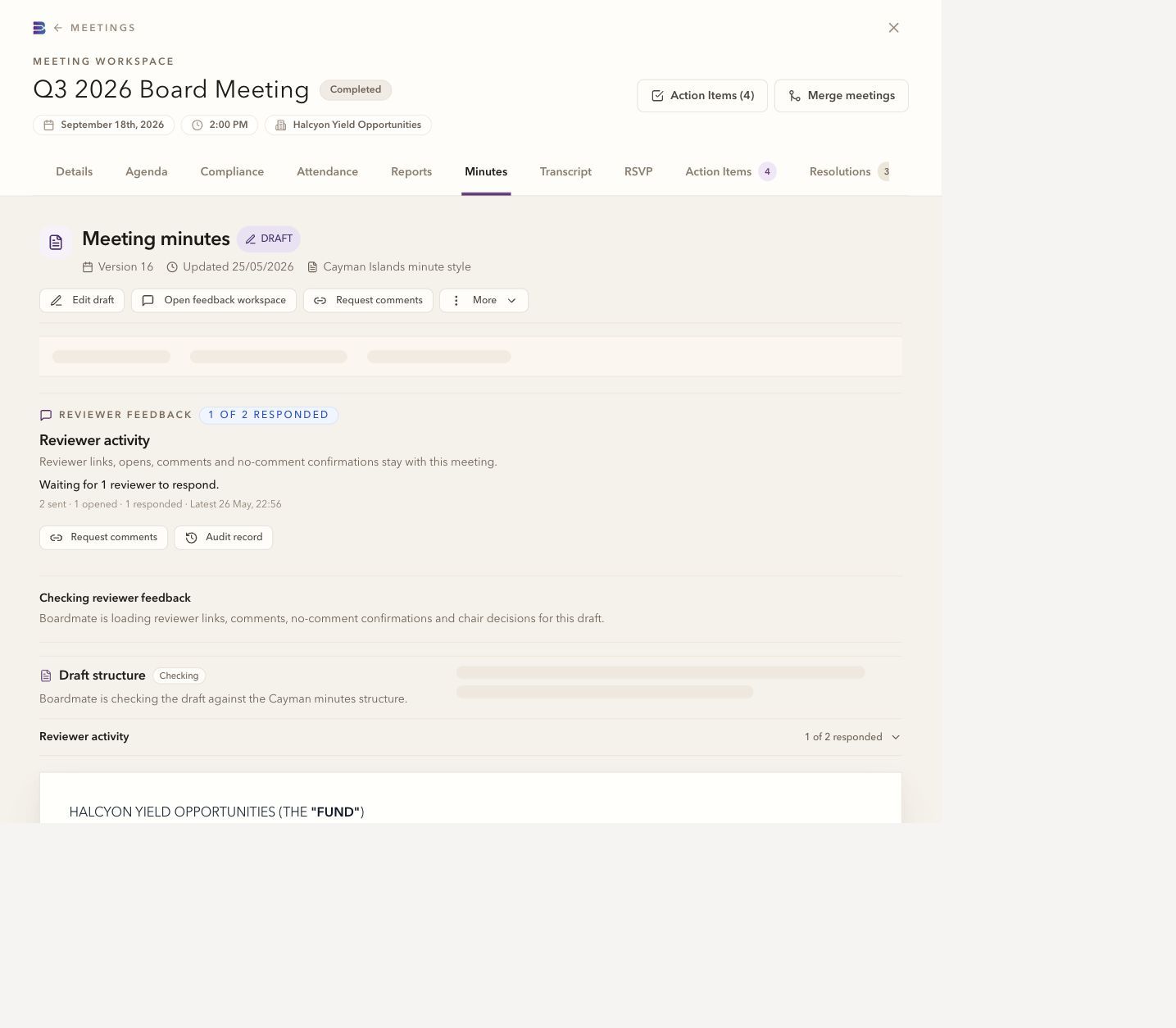
Use prior approved minutes to test whether Boardmate matches your structure, wording, and level of detail.
Use this when a team wants to know whether Boardmate can draft formal minutes that feel recognisable to the organisation, rather than producing a generic account of what was discussed.
01
Material to bring
Recent approved ordinary minutes, plus one meeting with substantive decisions or sensitive discussion.
Any board support template, boilerplate note, defined-term convention, resolution wording, or legal-review guidance currently used.
Examples of minutes that were considered too thin, too full, or too informal if the team has them.
A chair or board support owner who can distinguish style preference from factual correction.
02
Boardmate checks
Does the draft keep formal structure without flattening every meeting into the same template?
Are resolutions, approvals, deferrals, actions, and sensitive matters phrased with appropriate legal restraint?
Can selected-passage feedback refine wording without letting every reviewer impose their own style?
Do DOCX, PDF, on-screen rendering, and audit history stay aligned enough to avoid formatting distrust?
03
Red flags
The minutes read fluently but miss the organisation's normal level of detail, decision language, or defined terms.
Reviewers rewrite for personal preference and chair control is not used to keep style disciplined.
Prior minutes supplied for style are old, unapproved, or from a different entity format without that being marked.
The exported DOCX needs so much repair that the product has only moved the work, not reduced it.
Result of the exercise
Style note
Record the wording patterns, recurring sections, and judgement points to preserve next time.
Decision examples
Keep a few accepted and rejected comments that show how house style is being protected.
Output check
Confirm the DOCX is a credible working artefact with structure, formatting, and review history.
Boardmate view
House style is the organisation's record habit. It includes section order, headings, defined terms, resolutions, recurring boilerplate, action wording, sensitivity, and the amount of discussion a formal record should carry. It also includes what the minutes do not say.
A Boardmate style evaluation works best with approved examples, not vague preference. The strongest examples show ordinary meetings, substantive decisions, recurring language, and any recent change in approach. The team can then see whether Boardmate drafts minutes that a real board support lead can review as real work.
Worked examples, checklists and planning tools
House-style detail
House style is a standard of judgement, not a prettier voice.
A product can produce fluent minutes and still fail the house-style test. Board minutes carry conventions about what is material, how decisions are recorded, how resolutions are worded, how sensitive discussion is restrained, and how recurring items move from one meeting to the next.
A proper style evaluation therefore needs approved examples and an authorised reviewer. The examples teach Boardmate what current style looks like. The authorised reviewer separates factual correction, chair preference, legal sensitivity, and personal rewrite.
Record
Use approved minutes, not remembered taste.
Current approved examples are the strongest style source because they show structure, restraint, defined terms, and recurring board language in context.
Judgement
Read decisions and silence carefully.
The style test includes what the minutes omit: unnecessary debate, unsupported commentary, and detail the organisation would normally treat as immaterial.
Authority
Let the chair or delegate decide style changes.
Reviewers can identify issues, but broad style shifts become source material only when the authorised person accepts them.
How to run it
Build a style test that survives more than one meeting.
The aim is to learn whether Boardmate can preserve the organisation's record habit across ordinary, sensitive, and decision-heavy material.
01
Create a current style pack.
Collect recent approved minutes, a current template if one exists, recurring boilerplate, resolution wording, and any note explaining old style versus current style.
Approved minutes
Template
Style exceptions
02
Mark the passages that matter most.
Approvals, conflicts, resolutions, matters arising, sensitive discussion, defined terms, and action wording deserve closer reading than general narrative paragraphs.
Key passages
Materiality points
Legal wording
03
Classify reviewer comments.
Separate factual corrections, support uploads, personal preferences, legal concerns, and chair instructions before regeneration.
Comment type
Accepted feedback
Rejected preference
04
Open the DOCX like the person responsible for the final file.
Check headings, numbering, tables, signatures, line breaks, defined terms, and any formatting the team would otherwise repair manually.
DOCX structure
Formatting defects
Final handling effort
05
Write a reusable style note.
The evaluation leaves a short note that says what Boardmate followed, what was corrected, and what carries into the next run.
Style note
Chair decision
Next sample
Worked scenario
Where style tests usually become important.
The first Boardmate draft follows the broad structure well, but a legal reviewer thinks one sensitive discussion is recorded too fully. An attendee also suggests a friendlier phrasing for a resolution. The chair accepts the sensitive-passage correction, rejects the friendly resolution rewrite, and asks Boardmate to preserve the approved resolution form.
That is a useful result. It shows the review workflow can protect house style from both under-recording and over-editing. The next draft is judged against the accepted decision set, not every comment that arrived.
Accepted
A legal restraint correction with chair authority.
Rejected
A style rewrite that conflicts with approved resolution wording.
Carried
A reusable instruction about sensitive discussion treatment.
Checked
DOCX structure and final handling effort after export.
A good result
Structure
The draft follows the organisation's usual order and formal section logic.
Materiality
Important decisions are recorded; immaterial discussion is restrained.
Continuity
Matters arising, definitions, reports, and actions do not lose board memory.
File quality
The exported DOCX supports final handling without reconstruction.
Boardmate review
Use this guide to test house style through approved wording, materiality, formal restraint, and DOCX usefulness.
Style source
Approved prior minutes, current templates, boilerplate, defined terms, and resolution examples anchor the test.
Judgement surface
The reviewing team reads decisions, resolutions, deferrals, actions, matters arising, sensitive passages, and silence around non-material discussion.
Structure checks
Boardmate can surface missing expected papers and structure decisions as review prompts, not automatic blockers.
Working file
The DOCX is inspected for headings, numbering, tables, spacing, signature blocks, defined terms, and legal formatting conventions.
Worked example
Example style pack.
A good style pack might contain two recent ordinary minutes, one minute with a substantive approval, one minute with sensitive discussion, a current template, and a short note identifying old style versus current style. That pack gives Boardmate record and gives the reviewer something concrete to judge against.
Style review should be stricter around formal passages. A draft can sound fluent but still fail if it over-records a sensitive exchange, loses the organisation's resolution wording, omits matters arising, or treats a one-off chair preference as a permanent house rule.
Current style
Recent approved minutes the team wants Boardmate to follow.
Historical style
Useful context, but not the preferred format for future minutes.
Exception
Special wording that should not become a default instruction.
Decision ledger
StageTeam questionBoardmate recordDecision
Collect
Do we have enough recent approved minutes to judge style fairly?
Prior minutes, templates, current boilerplate, and marked exceptions.
Delay style scoring if examples are stale, mixed, or unofficial.
Draft read
Does the draft preserve formal record judgement?
Attendance, apologies, conflicts, reports, decisions, resolutions, deferrals, and action treatment.
Separate factual errors from style preferences before reviewers comment.
Reviewer input
Which comments improve the record and which only reflect personal taste?
Use accepted corrections and chair instructions for regeneration, not a loose markup pile.
Output
Would board support work from this DOCX without rebuilding it?
DOCX structure, PDF consistency, audit trail, and a reusable style note.
Proceed if the file is useful; retest if formatting or structure still creates heavy repair work.
Watch points
Pretty prose trap Readable minutes are not enough if decisions, materiality, and formal restraint are wrong.
Preference capture A reviewer may rewrite style without authority, so chair moderation matters.
Template overreach One unusual meeting should not teach Boardmate a permanent rule for every future fund.
Boardroom wording
To legal We are judging materiality, restraint, approved wording, and fluency together.
To reviewers Please mark factual corrections and record; style preferences need chair authority.
To board support The DOCX should reduce final handling, not move formatting work to the last step.
Boardmate toolkit
Separate formal style from personal rewriting.
A house-style guide is useful only when it distinguishes approved convention, materiality, legal restraint, chair preference, and individual taste. Boardmate can follow a style when the team supplies source material and lets the right person decide which corrections become durable instructions.
Briefing note
The style pack shows what the organisation actually approves.
Approved prior minutes are the style reference. They show headings, attendance treatment, declarations, report language, resolutions, matters arising, action wording, and the level of detail the board accepts. Drafts and markups can help, but they must be labelled as unfinished.
Current examples
Two or three recent approved minutes that represent the style to follow now.
Hard examples
One sensitive, decision-heavy, or legally reviewed minute that shows restraint and wording.
Exceptions
Old style, one-off chair preference, unusual transaction wording, or material that must not become a default.
Prior minutes
Style reference
Prior approved minutes help Boardmate avoid a generic summary voice and give reviewers something concrete to compare.
Paper view
Minutes as a separate record
Read the draft as formal minutes, with its own paper-like surface, not as a chat transcript or a generic document preview.
Comments
Passage-specific correction
Style feedback is strongest when it points to the exact passage and says whether the issue is fact, materiality, sensitivity, or convention.
Regeneration
Accepted instructions only
Broad rewrites become source material only when the chair or delegate accepts them.
Role by role
Board support
Prepare the style pack and identify what is current, old, exceptional, or legally sensitive.
Approved minutes, template, boilerplate, defined terms, and style exception note. Chair
Decide whether a preference shapes regeneration or remains an individual comment.
Accepted style instructions, held issues, and rejected rewrite preferences. Legal reviewer
Mark materiality, privilege, sensitivity, and resolution wording without rewriting ordinary prose unnecessarily.
Passage comments, support uploads, and legal wording references. Administrator
Check recurring reports, service provider names, fund terms, and prior-minute continuity.
Report wording, defined terms, actions, matters arising, and recurring boilerplate.
Decision route
Vague
Reviewers say it does not sound like us, but no one supplies approved examples.
Collect current minutes before scoring style. Reviewable
The draft follows section order, formal tone, and routine decision language well enough for comments.
Run a controlled style review. Authorised
Factual corrections, legal sensitivity, chair preference, and personal taste are separated.
Regenerate from accepted instructions only. Durable
The evaluation leaves a reusable style note and a clear view of what Boardmate followed.
Use the style pack for the next sample.
Record note
Style calibration note
This is the note that stops style from becoming a debate about taste. It names the record and the decision authority.
Follow
Current approved minutes from March and April, plus the present template and resolution wording.
Do not follow
Older administrator format and one historic minute with unusual transaction-specific language.
Watch
Sensitive director discussion, conflicts, matters arising, and recurring report wording.
Authority
Chair accepts style instructions before regeneration; legal marks sensitivity only.
Avoid
Fluent but wrong Smooth prose can still fail if it over-records discussion or loses formal decision wording.
Preference capture A confident reviewer can accidentally teach the system a personal habit.
Old examples Prior minutes from the wrong administrator or period may describe a style the team no longer wants.
Formatting afterthought DOCX structure is part of house style, not a final cosmetic clean-up.
Style reference
Use approved minutes as source material.
Prior approved minutes show Boardmate what the organisation considers acceptable. They show how attendance is recorded, how declarations and conflicts are handled, how reports are introduced, how resolutions are worded, and how matters arising carry forward. Working drafts and unresolved markups can be useful context, but they should be marked as such.
A single example can help with formatting, but a small run of examples is better for judgement. It shows what stays consistent and what varies by meeting type. If the organisation has changed administrator, chair, fund structure, or legal style, mark which examples are current.
Style pack contents
Two or three recent approved ordinary minutes.
One minute with substantive decisions or sensitive discussion.
Any template, boilerplate, defined-term list, or legal-review guidance.
A note identifying old style, current style, and exceptions.
Style source note
Current
Approved examples the team expects Boardmate to follow.
Historical
Useful for context but no longer the preferred pattern.
Exception
Special wording that should not become a default.
Judgement
Separate formal judgement from surface wording.
Minutes can read smoothly and still fail the style test. The team can check decisions, resolutions, deferrals, actions, and sensitive passages separately from general prose. A good draft should preserve legal restraint where the transcript is informal, and it should not over-record debate where the organisation normally keeps the record concise.
The review should also look for lost continuity. Matters arising, responsible people, recurring report references, and prior decisions often carry the memory of the board. If those patterns vanish, the draft may look tidy but still fail the working needs of the team.
Read these passages closely
Approvals, resolutions, deferrals, and action wording.
Sensitive passages where restraint and materiality matter.
Matters arising and carry-forward items.
Defined terms, fund names, director names, service provider names, and committee references.
Style judgement log
Accepted
Boardmate wording that matches house style or improves clarity.
Refined
Wording that needs a style instruction before regeneration.
Rejected
Reviewer wording that conflicts with formal record style.
Reviewer control
Use comments to improve style without letting preference take over.
Reviewers may spot factual problems, but they often bring personal style preferences. The chair or delegated board support lead should decide which comments change the next draft. That decision point protects house style from becoming a negotiation between every reviewer who received a link.
Selected-passage comments help because they keep feedback attached to the wording under review. Uploads can provide support for a correction. No-comment confirmations show who has read the draft. The regeneration basis should be the accepted decision set, not a loose collection of edits.
Support record: uploaded paper, note, action list, or late clarification.
Output
Check the DOCX because style lives in the working file.
A website preview can look polished while the working DOCX still creates repair work. The team should inspect the exported file as the board support team would use it: headings, spacing, numbering, signatures, table behaviour, line breaks, names, dates, boilerplate, and any legal formatting conventions.
If the exported file needs only ordinary final handling, Boardmate has probably preserved the practical style surface. If it needs heavy reconstruction, the evaluation should say that plainly and decide whether the issue is source quality, style instruction, template configuration, or product output.
Output checks
DOCX structure, headings, numbering, spacing, and tables.
PDF reading copy and whether it matches the final DOCX intent.
Audit trail for style comments and chair decisions.
A reusable style note for the next Boardmate run.
Questions to settle
Which prior minutes are approved and current enough to use as style reference?
Where does the organisation prefer concise judgement over fuller discussion?
Which reviewer comments are factual corrections and which are style preferences?
Does the exported DOCX reduce final formatting work?
What style instruction should Boardmate carry into the next batch?
House style is more than tone. It includes what the minutes choose to record, what they leave out, how decisions are framed, how recurring sections are handled, and how formal language is kept consistent across meetings.
Section order, headings, attendance format, apologies, quorum, declarations, approvals, matters arising, and close.
Resolution wording, action phrasing, chair language, and the level of discussion detail.
Defined terms, fund names, director names, service provider names, and committee references.
Recurring boilerplate for conflicts, notices, reports, financial statements, delegated authority, and regulatory matters.
Visible style
Structure, vocabulary, headings, and formatting.
Hidden style
Judgement about materiality, discretion, repetition, and what belongs in the formal record.
Source examples
Prior approved minutes are source material.
A single prior minute can be helpful. A small run of approved minutes is better because it shows what stays stable and what changes by meeting type. Use examples that are genuinely approved, not working drafts with unresolved comments.
Provide at least one recent ordinary meeting and one meeting with substantive decisions.
Include any existing template or marked-up style guidance used by board support.
If the organisation has recently changed format, include both old and new examples and identify the current preference.
Remove or restrict anything that should not be used as style reference.
Decision language
Check resolutions and decisions separately from prose.
Minutes can sound polished and still fail if the decision language is wrong. During evaluation, review every resolution, approval, instruction, deferral, and action against the board's expected wording.
Approval
Does the wording make clear what was approved and by whom?
Discussion
Is the level of detail proportionate to the organisation's normal record?
Action
Is the owner, next step, or carry-forward point expressed in a usable way?
Deferral
Does the draft avoid treating unresolved matters as approved?
Sensitivity
Does the record stay formal where the transcript was informal or commercially sensitive?
Reviewer input
Use review to refine style without surrendering control.
Attendees and service providers may spot factual problems, but the chair or delegated board support owner should decide which comments become source material for regeneration. That distinction is part of house-style control.
Ask reviewers to comment on specific passages instead of rewriting the whole document in their own style.
Treat uploaded support as context, not as automatic replacement wording.
Keep chair instructions separate from general reviewer comments.
Use accepted feedback to regenerate a cleaner draft and keep rejected feedback visible in the record.
Common failure modes
Watch for minutes that sound generic.
Generic minutes often look tidy on first read and then fail under legal or board support review. The evaluation should actively look for that failure rather than waiting for it to surface at approval.
Too full
The draft records every turn of conversation and loses formal judgement.
Too thin
The draft misses the reason for decisions, director concerns, or carry-forward actions.
Wrong register
The wording sounds like a summary, sales note, or transcript digest rather than approved minutes.
Lost continuity
Matters arising, prior wording, or repeated board patterns do not carry forward.
Record
Keep style decisions with the final record.
A mature house-style process leaves enough material to explain why the final draft changed. That record matters when a director, legal reviewer, or service provider asks how a passage became final.
Retain prior-minute sources used for style comparison.
Record chair decisions on reviewer comments before regeneration.
Keep DOCX, PDF, actions, and audit history together.
Use the evaluation to create a short style note for the next Boardmate run.
Common questions
House-style questions before generation.
Which prior minutes help Boardmate learn house style?
Use approved minutes that show current wording for constitution, conflicts, resolutions, reports, actions, defined terms, and closing language.
What if existing minutes are inconsistent?
Call out the preferred approach before generation. Inconsistency is useful when it shows where the chair or legal reviewer needs to set the standard.
Can house style include formal legal wording?
Yes. Defined terms, resolution wording, confidentiality language, and recurring Cayman fund sections can be treated as part of the drafting context.